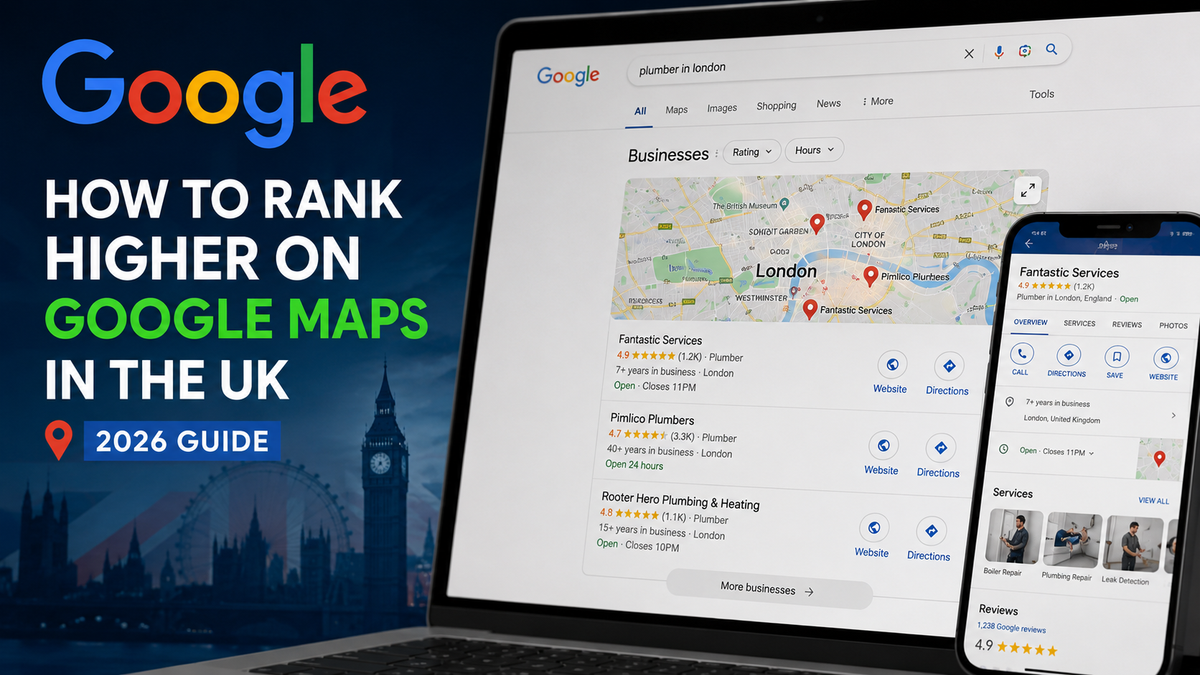
Why Google Maps Rankings Matter More Than Ever
When people need a service today, they rarely scroll through pages of search results. Instead, they search for terms like “dentist near me,” “plumber in London,” or “best accountant in Manchester.” The first thing they often see is the Google Map Pack, displaying local businesses complete with reviews, opening hours, directions, and contact information.
For UK businesses, appearing in these results can generate a consistent stream of highly qualified enquiries without relying solely on paid advertising. If your business isn’t visible on Google Maps, you’re likely missing out on customers who are actively searching for the services you offer.
This guide explains the key factors that influence Google Maps rankings and the practical steps you can take to improve your visibility.
What Determines Google Maps Rankings?
Google primarily evaluates three factors when deciding which businesses appear in local search results:
Relevance
How closely your business matches what someone is searching for.
Distance
How close your business is to the searcher’s location or the location included in their search.
Prominence
How established and trustworthy your business appears online.
While you cannot control where a customer searches from, you can significantly improve your relevance and prominence.
1. Optimise Your Google Business Profile
Your Google Business Profile is one of the strongest local ranking signals.
Ensure your profile includes:
- Accurate business name
- Primary and secondary business categories
- Correct phone number
- Website URL
- Business description
- Opening hours
- High-quality images
- Services and products
- Questions & Answers
- Attributes relevant to your business
Avoid keyword stuffing your business name, as this may violate Google’s guidelines and lead to profile suspension.
2. Maintain Consistent Business Information
Your business information should remain consistent across every online platform.
Your:
- Business name
- Address
- Phone number
should match exactly across your website, directories, and Google Business Profile.
Inconsistent information creates confusion and reduces trust signals.
3. Build SEO-Optimised Location Pages
One of the biggest mistakes businesses make is trying to rank one homepage for every city.
Instead, create dedicated location pages targeting each service area.
Examples include:
- Website Design London
- SEO Agency Birmingham
- Digital Marketing Manchester
- Electrician Leeds
- Physiotherapist Bristol
Each page should contain unique content written specifically for that location rather than duplicated text.
Location pages allow Google to better understand the geographical areas your business serves while improving visibility for multiple local searches.
4. Collect Genuine Customer Reviews
Reviews are among the strongest trust signals for Google Maps.
Businesses with consistent, high-quality reviews often outperform competitors with outdated or inactive profiles.
Encourage satisfied customers to leave honest reviews after completing a project.
Respond professionally to every review, including negative ones.
Google values businesses that actively engage with customer feedback.
5. Upload Fresh Photos Regularly
Businesses that regularly update their Google Business Profile often appear more active and trustworthy.
Upload:
- Team photos
- Office images
- Completed projects
- Before & after work
- Product images
- Company vehicles
- Behind-the-scenes content
Fresh content demonstrates that your business remains active.
6. Strengthen Your Website
Google doesn’t rank your Google Business Profile in isolation.
It also considers your website.
A strong website should include:
- Fast loading speeds
- Mobile-friendly design
- Clear navigation
- Service pages
- Location pages
- Contact information
- Internal linking
- Technical SEO
- Schema markup
Your website and Google Business Profile should support each other.
7. Publish Helpful Local Content
Content remains one of the most effective long-term SEO strategies.
Rather than writing generic blogs, publish articles that answer questions your local customers are already asking.
Examples include:
- How Much Does Website Design Cost In London?
- Best Local SEO Strategies For Small Businesses
- Why Google Reviews Matter For UK Businesses
- How To Improve Your Google Business Profile
Helpful content builds authority while increasing opportunities to appear in local searches.
8. Build Local Authority
Google wants to recommend trusted businesses.
Authority can be strengthened through:
- Local business directories
- Industry associations
- Local partnerships
- Community involvement
- High-quality backlinks
- Press mentions
Quality matters far more than quantity.
9. Improve Website Performance
A slow website doesn’t just frustrate visitors.
It can reduce conversion rates and negatively affect your search visibility.
Focus on:
- Core Web Vitals
- Fast loading pages
- Image optimisation
- Clean code
- Mobile responsiveness
- Secure HTTPS connections
Performance directly influences both user experience and search performance.
10. Stay Active
Google prefers businesses that demonstrate consistent activity.
This includes:
- Posting Google Business updates
- Adding new images
- Responding to reviews
- Updating services
- Publishing blog content
- Refreshing website information
Small, consistent improvements often outperform occasional major updates.
Common Mistakes To Avoid
Many businesses struggle because they:
- Ignore their Google Business Profile after creating it.
- Use duplicated location page content.
- Have inconsistent contact information.
- Neglect customer reviews.
- Fail to optimise their website.
- Use slow, outdated websites.
- Expect immediate SEO results.
- Focus only on rankings rather than customer experience.
Avoiding these mistakes can significantly improve your long-term visibility.
The Bigger Picture
Ranking higher on Google Maps isn’t about finding a single trick or shortcut.
Successful businesses combine multiple strategies into one cohesive system, including:
- A high-performing website
- Strong technical SEO
- Well-optimised location pages
- Google Business Profile management
- Positive customer reviews
- Helpful content
- Local authority
- Ongoing optimisation
When these elements work together, they create a stronger digital presence that improves visibility, builds trust, and generates more enquiries over time.
Final Thoughts
Google Maps has become one of the most valuable customer acquisition channels for local businesses across the UK.
The businesses that consistently appear in local search results aren’t necessarily the largest. They’re the ones that invest in creating a complete digital foundation that supports long-term visibility.
Improving your Google Maps rankings takes consistency, strategy, and ongoing optimisation, but the rewards can be significant. By focusing on customer experience, local relevance, and technical best practices, your business can build a stronger presence where potential customers are already searching.
Ready To Improve Your Local Visibility?
At Nexify Dot, we’ve developed GrowthOS™, a complete business growth system that combines website development, local SEO, Google Business Profile optimisation, location pages, and conversion-focused strategies to help businesses strengthen their online presence and generate more qualified enquiries.
Book a Growth Strategy Call and discover how your business can improve its visibility across Google Search and Google Maps.